The refrigerator and the shovel.
Two questions run the early board meeting: what is the traction, got any letters of intent. Founders answer with motion. The good overseers know the difference, and they know when they are handing a founder a shovel instead of the refrigerator they actually need.
The board meeting I performed instead of used
I have been the founder in that room. Corporate investors around the table, an enterprise due-diligence playbook built for a company ten times our age, and the same two questions every time: what is the traction, and have you got any letters of intent. Fair questions. Also where the trouble started.
I answered the way a frightened founder answers. I brought motion. A new logo. A cleaner website. A booth at the next conference. A deck with sharper numbers. A month of it, all of it real, none of it the thing they were actually asking about. Because the thing underneath those questions was the one task I was quietly avoiding: getting in front of real buyers, exposed, to find out what was true.
It did not just miss. The pressure pushed us closer to the edge. I was performing the board meeting instead of using it, and the board was handing me a shovel when what I needed was a refrigerator. I did not have those words then. I do now.
The board asked for traction. I produced activity. We both mistook the second for the first.
The shovel and the refrigerator
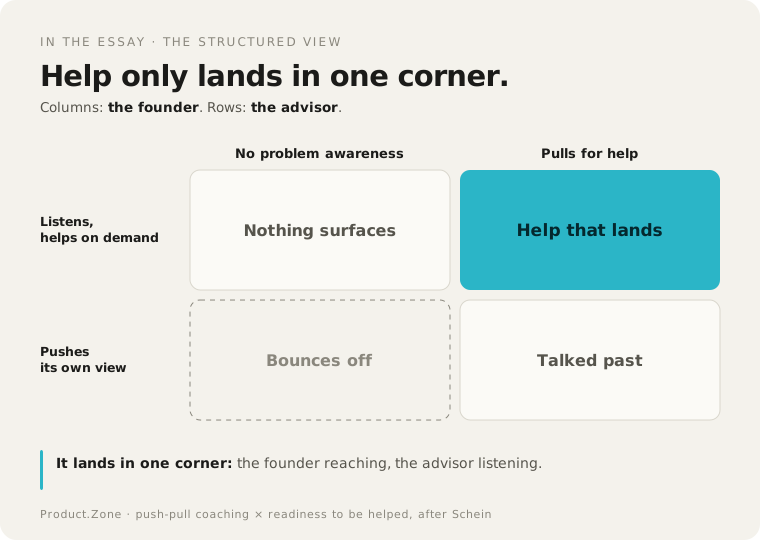
I have since sat on the other side of that table too, so I will say it plainly. Most of the oversight I have sat through is a shovel: everything the investor already knows, pushed at the founder, and pushed harder the moment the numbers wobble. What the founder needed was a refrigerator. Help that is there when they reach for it, in the form they can use, at the stage they are actually in.
The shovel makes the investor feel useful. The refrigerator makes the venture move. They are not the same act, and the shovel is the only tool many boards pick up.
Good oversight starts with that distinction: diagnosis, not reflex. Most of it fails right there.
The call you keep not making
Here is the uncomfortable part, and it is not the board’s fault alone. Founders avoid the exposing work. Talking to a stranger who might say the idea is wrong, on a call where you cannot hide behind the product, is the most vulnerable thing in the job. So it gets postponed. There is always a logo to fix, a page to polish, a conference to attend, an update to write. All of it feels like progress. None of it puts you in front of the one person whose “no” you actually need to hear.
This is not laziness. It is self-protection, and it is completely human. It is also where ventures quietly die: not from a lack of effort, but from months of effort aimed everywhere except the place that hurts.
And the board’s pressure makes it worse. Push hard for traction, and a frightened team will manufacture the cheapest thing that looks like it. You get the theater, not the truth. Inside a corporate parent it is worse still, where the founder runs a startup and corporate politics at once, measured against a curve that has nothing to do with their stage.
You are funding a search, not a company
So change the question. At this stage you are not funding a company. You are funding a search: whether this team can turn a noisy, uncertain market into evidence, fast, without losing the nerve to keep looking. What you underwrite is not the plan. It is whether they are a learning machine or a product machine.
A learning machine has tells. Its customer bets change when the evidence changes. It kills weak bets quickly instead of nursing them. It comes back from conversations with something it did not know before. Its focus narrows over time, not widens. A product machine just ships, beautifully, into a market it has not yet understood.
The signal that holds up lives inside that search, and it is quiet. Not the raise, not the outreach numbers, not the conference. It is one real buyer who cannot wait to get their hands on the product, rough as it is, asking when they can have it, as if they needed it yesterday. Demand you can serve again and again. Once a venture has it, capital follows almost on its own. Before it, capital just buys time.
Diagnosis, not reflex
None of this means hands off. It means the opposite of reflex. The best help is precise, not broad: one or two real buyer introductions, a hard look at who the product is actually for, a pricing pressure-test, a decision forced when the team is carrying too many bets at once. Reduce the uncertainty without replacing the founder’s judgment. That is the refrigerator, stocked.
And sometimes the right move is pressure. Sometimes revenue is exactly the constraint, and a board that waits for perfect customer truth waits the venture into the ground. The test here is diagnosis, not reflex.
A board that pushes because it diagnosed the real constraint is doing its job. A board that pushes because pushing is what boards do is just shoveling.
Where this view is too clean
A seasoned investor will push back, and the pushback is fair. Some founders use “let me move at my own pace” to dodge a reckoning the market has already delivered, and a board that respects pace too much becomes an accomplice to denial. The refrigerator assumes the founder knows when to reach and what to reach for, which is exactly what an inexperienced founder lacks. There are moments when overriding the founder and forcing the hard call is the thing that saves the company.
All of that is true. It does not rescue the reflex. It just raises the bar on the diagnosis. The whole craft is knowing which one you are doing, and most overseers never ask. The good ones ask first, every time, before they reach for the shovel.
The quieter signal, in your inbox.
Notes and pieces on what actually moves ventures, from the work. No noise, no schedule for its own sake. Leave any time.