Everyone is acting as if.
The European startup world delays the one moment that tells the truth, a real customer deciding with money attached, and rewards everything that postpones it.
When I was eight I set up a booth and sold my family’s whole candy stock to the neighbourhood kids. Other kids played shop with a cardboard till and wooden food. I wanted the real thing, so I sold the real candy. Every sweet gone by the end of the day. The kids happy. Me behind an empty table feeling like a winner. I’d priced it all in small change, so there was some money in the tin, nowhere near what the candy had cost. Sell everything, please everyone, lose money on every piece. It looked like a roaring success and it couldn’t have run a second day.
That’s the day I learned to sell. It took me the better part of forty years to learn the rest.
Here is the one thing this whole piece argues. The European startup world delays the one moment that tells the truth: a real customer deciding, with money attached. And it rewards everything that postpones that moment.
In Europe, you can look like a founder for years before you have to be one.
Not a money problem. Not a courage problem. A delay problem, dressed up as progress.
I’m not judging this from outside. I spent over a decade as a corporate animal, then built a marketplace that moved 1.5 billion euros in transactions. I knew which offerings would convert between the buyers and sellers on the platform. What I never worked out was how to grow the buyers and sellers themselves, repeatably and predictably, the way a founder has to grow their own customers. An empty shelf that feels like a win. I know the gap from the inside, because I lived in it for years and called it success.
What it looks like up close
A founder tells me “we sell to customers.” I press on it. What he means is he stood at a fair, talked to people, and one good conversation turned into them wanting to sell to him too. He’s not lying. He felt something real. He just filed a warm chat under “sales,” because sales is the word that gets him claps. He has no way to tell a nice conversation apart from money that will actually move.
I did the same thing for years, at a much bigger scale. A full pipeline that felt like selling and was mostly motion. The look of the thing had eaten the thing, and I couldn’t see it happen.
Now run it one floor up. A founder builds a startup for eighteen months. It dies. And he walks on stage to tell a room of founders he now knows the problems to solve, so they don’t have to find out themselves. Based on what? Based on surviving long enough to build a story. He passed the test the room rewards, which is sounding like you know. He can’t tell his own story about the problems apart from the ability to solve them. So he sells the story, in full sincerity, to a room of founders who also can’t tell the difference. Nobody in that exchange is a liar. The exchange clears anyway. Story for story.
That is the engine. Hold it, because it runs every layer that follows.
The corporate version, which is worse
A big company decides it wants in. It spins up a venture arm, an innovation lab, an accelerator with the logo on the wall. Fine. Then it does the thing that gives the game away. It picks its own senior people to coach and to rate startups, and stages an innovation celebration to hand out the verdicts.
Ask the only question that matters. Based on what?
A corporate executive’s authority is itself a thing that only looks like the real thing, for this job. It was earned inside a system that pays out on budget defended, headcount grown, politics survived. Almost none of it was ever checked against the one test a startup has to pass: build something from nothing that a stranger will choose to pay for. Some of these executives have shipped real products. Most of the ones handing out the verdicts that night have not. So you get one untested authority grading another untested pitch, at an event whose real product is the feeling of innovation. The failed founder at least once stood at the fair. The corporate judge often never did, and yet he is the one handing out the verdicts.
Why it runs forever
A delay this big should get caught. It doesn’t, because almost no one is ever measured at the table where the order was placed.
The founder who mistook a fair chat for a sale finds out eighteen months later, and by then he isn’t on trial, he’s on stage. The accelerator that brags its graduates raised more money never has to answer for whether the company stood on its own, because by the time it folds the cohort is three years gone and everyone has an excuse. The corporate lab books the innovation night as a win and never checks the morning. The bill always lands on someone other than the person who ran it up.
Even the honest research has the same problem: it measures what’s easy to count. Graduates raised more money, faster, and hired more people. The studies I’ve seen mostly count inputs pulled in, not a business that stands without them. And the researchers say out loud they can’t separate the programmes that help from the ones that only picked winners. The people grading the support layer are stuck measuring the look of it too.
What the Valley actually has
The usual story reaches for grit and money here, and the usual story is wrong. The Valley founder isn’t braver, and per head isn’t richer. The Valley just makes you find out faster, and it is crueler about it. I spent time with founders there in 2017. Ship in weeks. The customer pays or doesn’t. The gap between “they liked it” and “they bought it” closes fast, and in public. The dense network and fast feedback everyone admires aren’t luxuries. They drag your pretending to the cash register early, while there’s still time to learn from the answer. Europe’s slower, kinder, more subsidised loop is what lets the delay run untested for years. The kindness is the disease.
The man who named it says the same thing
Andy Rachleff coined the term “product-market fit,” and he spends a whole interview describing this exact problem. Founders think they have it, he says, because “they’ve paid for growth and the company grows quickly.” Paid growth is the empty shelf, the customers you buy don’t stay. When a prospect says “maybe, if you add these features,” he treats it as a no: “maybe is worse than no, it’s no with false hope.” And the clean origin stories everyone learns from? “They all revise history once they succeed.” He even admits he only understood his own idea after he stopped practising it.
His test for whether someone is actually desperate: when you describe what you would build, do they almost reach across the table and grab you by the collar, asking when they can have it. Everything short of that is the show.
The test
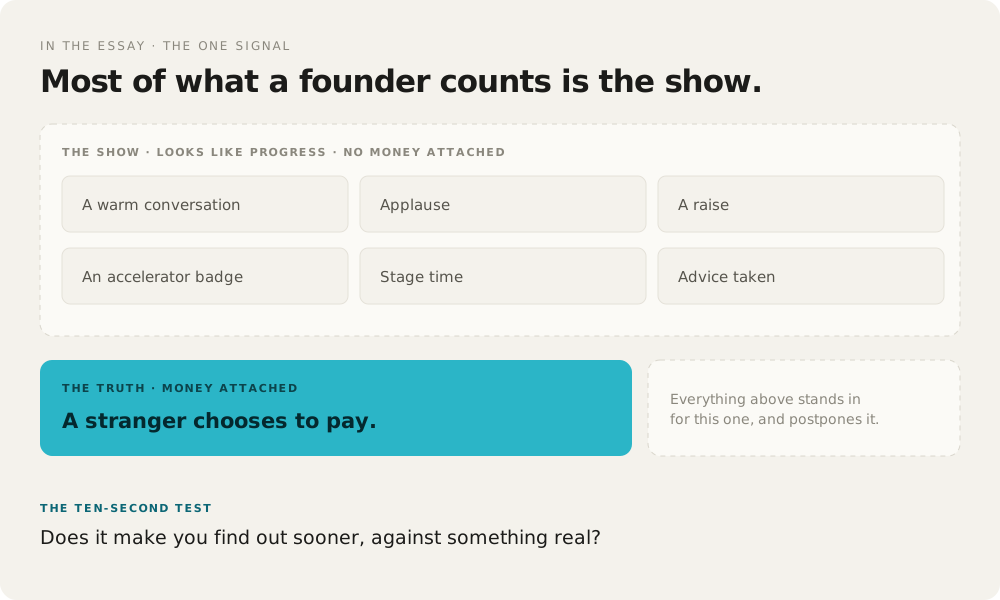
So here is the only test that separates real help from the performance. You can run it in ten seconds on any event, coach, programme, or judge.
Does it make you find out sooner, against something real? Or does it postpone the reckoning and sell you a good feeling for the wait?
Help that sends you to get a real no this week is real. A conversation that ends with you putting a number in front of a stranger is real. Anything that sends you home feeling more like a founder and no closer to finding out is the show, no matter whose logo is on the badge.
I’m done clapping for it. I emptied a shelf at eight and thought I’d won, and I was losing money on every sweet. The founders I work with deserve to find out which one they’ve got, the roaring success that can’t run a second day or the real thing, early, while it’s still cheap to find out. Even when it stings. That’s the whole job.
The quieter signal, in your inbox.
Notes and pieces on what actually moves ventures, from the work. No noise, no schedule for its own sake. Leave any time.